
Overtraining syndrome (OTS) is defined as a prolonged performance decline lasting months to years, caused by training stress that consistently exceeds your body's recovery capacity. For strength trainers over 40, the stakes are higher. Recovery slows, life stress compounds, and the line between productive hard training and genuine breakdown gets thinner every year. Learning to avoid overtraining signs and fixes that actually work requires understanding session RPE trends, energy availability, sleep quality, and total life load. This article covers all four.
What are the key signs of overtraining in strength trainers over 40?
Overtraining symptoms are not just feeling tired after a hard week. OTS is diagnosed only after ruling out conditions like anemia, depression, and thyroid dysfunction. That distinction matters. It means most people who feel "overtrained" are actually dealing with something more correctable: a mismatch between training demand and recovery resources.
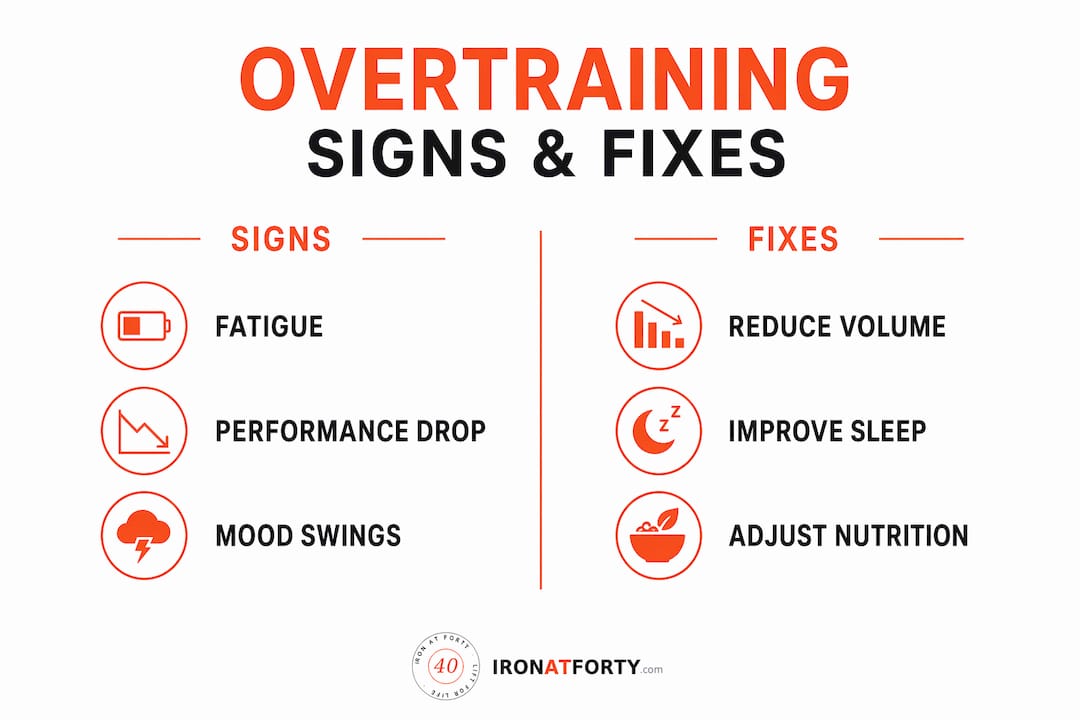
That said, the signs of excessive training are real and worth taking seriously. Watch for these:
- Persistent fatigue that does not improve after a rest day or two
- Rising session RPE at the same training weights over two or more consecutive weeks
- Prolonged soreness lasting more than 72 hours after a standard session
- Mood changes including irritability, low motivation, and anxiety
- Sleep disruption such as difficulty falling asleep or waking up unrefreshed
- Declining performance across multiple lifts over several weeks
The overlap with other conditions is real. Low energy availability drives many OTS-like symptoms and is especially common in lifters who restrict calories while training hard. This condition, known clinically as Relative Energy Deficiency in Sport (RED-S), produces fatigue, hormonal disruption, and performance loss that mirrors overtraining almost exactly. If you are cutting weight while pushing volume, RED-S is the first thing to rule out.
Normal training tiredness resolves within 48–72 hours. Overtraining symptoms persist, accumulate, and get worse with more training. That is the key difference. If you keep grinding through it expecting adaptation, you will dig a deeper hole.
How to monitor training load and recovery signals effectively
Session rate of perceived exertion (sRPE) is the most practical early warning tool available to a self-coached lifter. You rate how hard a session felt on a 1–10 scale, then multiply by session duration in minutes to get a training load score. The number itself matters less than the trend. Rising sRPE over two weeks at the same training load signals your recovery capacity is falling behind. That is your cue to act, not push harder.

Tracking this consistently is what separates lifters who catch problems early from those who end up forced off the platform for months. Ironatforty's guide on tracking training progress walks through exactly how to set this up without overcomplicating it.
| Signal | Normal response | Overtraining warning |
|---|---|---|
| Session RPE | Stable or decreasing over weeks | Rising for 2+ weeks at same load |
| Post-session soreness | Resolves within 48–72 hours | Persists beyond 72 hours |
| Sleep quality | Consistent, restorative | Disrupted, unrefreshed |
| Mood and motivation | Stable | Declining, irritable |
| Performance trend | Flat or improving | Dropping across multiple lifts |
Pro Tip: Review your sRPE scores once a week, not after every session. You are looking for trends, not daily noise. A single hard session means nothing. Two weeks of creeping numbers means something.
The bigger picture matters too. Most lifters who feel overtrained are actually dealing with total life load exceeding their recovery resources. A brutal work week, poor sleep, relationship stress, and a full training program stacked together will break you down faster than any single variable. Your body does not separate "gym stress" from "life stress." It all draws from the same recovery pool.
What nutritional and sleep strategies help prevent and fix overtraining?
Sleep is the most impactful recovery lever for lifters over 40. Losses in sleep quality degrade training capacity faster than almost any other variable. The numbers are stark: sleep restriction of five hours or less per night for three or more consecutive nights reduces sprint performance by 3.1% and raises perceived exertion by 17%. That means the same session feels harder and produces less output. For a lifter already flirting with overtraining, that is a compounding problem.
Here is how to address both nutrition and sleep systematically:
- Audit your energy intake first. Calculate your TDEE using Ironatforty's free TDEE calculator and compare it to what you are actually eating. A deficit of more than 500 calories per day while training hard is a setup for RED-S symptoms.
- Hit your protein floor daily. Aim for 0.8 to 1 gram of protein per pound of bodyweight. This is non-negotiable for recovery. Skimping on protein while in a caloric deficit accelerates muscle breakdown and fatigue.
- Time carbohydrates around training. Eating carbs before and after your sessions replenishes glycogen and blunts cortisol spikes. This is not about being perfect. It is about not training fasted and then under-eating for the rest of the day.
- Prioritize sleep duration and quality. Seven to nine hours is the target. If you are consistently under seven, address that before adding any training volume.
- Use CBT-I principles if sleep is disrupted. Cognitive Behavioral Therapy for Insomnia (CBT-I) is the evidence-based first-line treatment for chronic sleep problems. It outperforms sleep medication in long-term outcomes. A consistent wake time, limiting time in bed when not sleepy, and reducing screen light before bed are the core practices.
Ironatforty's meal prep guide for strength athletes covers the practical side of fueling recovery without spending hours in the kitchen every week.
Pro Tip: If your sleep is poor and your training is suffering, fix the sleep first. Adding a deload week while still sleeping five hours a night will not solve the problem.
How to adjust your training program to reduce overtraining risk
Abrupt increases in training frequency, intensity, or volume without adequate recovery are the direct cause of overtraining. The fix is not complicated, but it requires discipline. You have to manage the variables deliberately instead of just adding more whenever you feel good.
Periodization is the framework that makes this manageable. It means planning your training in phases with built-in variation in load and intensity. You are not supposed to push maximum effort every week. That is not how adaptation works. Planned tapering strategies, including linear, step, and exponential approaches, systematically reduce volume over two to three weeks to let your body consolidate gains and reduce injury risk.
Practical adjustments for lifters over 40:
- Schedule a deload every 4–6 weeks. Drop volume by 40–50% and keep intensity moderate. This is not optional. It is part of the program.
- Reduce frequency before reducing intensity. If you are feeling run down, cut a training day before you start lifting lighter. Frequency is the easiest variable to dial back without losing strength.
- Track your total weekly load score. Multiply sRPE by session minutes for each session and add them up. If your weekly total spikes more than 10% above your recent average, pull back.
- Sync training demand with life load. During high-stress periods at work or home, run a lower-volume training block. This is not weakness. It is training smart after 40.
- Vary exercise selection across mesocycles. Rotating movements reduces cumulative joint stress and keeps training productive without burning out specific patterns.
| Training variable | High-stress week adjustment | Normal week target |
|---|---|---|
| Weekly sessions | 2–3 | 3–4 |
| Volume per session | Reduce by 30–40% | Full planned volume |
| Intensity (% of 1RM) | Keep at 70–80% | 75–90% |
| Deload frequency | Every 3–4 weeks | Every 5–6 weeks |
If you have made genuine adjustments to load, nutrition, and sleep and still see no improvement, seek medical evaluation after 4–6 weeks. Persistent decline despite corrections points to an underlying medical issue, not a training problem.
Key takeaways
Overtraining in strength trainers over 40 is almost always a mismatch between total life and training stress and available recovery resources, and it resolves when you address load, sleep, and fueling together.
| Point | Details |
|---|---|
| Define OTS correctly | True overtraining syndrome requires ruling out medical causes like anemia or thyroid dysfunction first. |
| Use sRPE as your early warning | Rising session RPE over two weeks at the same load means recovery is falling behind. |
| Sleep is the top recovery lever | Five hours or less per night raises perceived exertion by 17% and kills performance fast. |
| Fix energy availability | Undereating while training hard triggers RED-S symptoms that mirror overtraining exactly. |
| Escalate if needed | No improvement after 4–6 weeks of adjustments means it is time for a medical evaluation. |
What I have learned about overtraining after years under the bar
The biggest misconception I see is that overtraining is a badge of honor. Lifters over 40 sometimes wear exhaustion as proof they are working hard enough. That thinking will end your training career faster than laziness ever would.
Real OTS is rare. What is common is accumulated life stress meeting a training program designed for a 25-year-old with eight hours of sleep and no mortgage. The fix is not always a deload. Sometimes it is a hard conversation about what your life actually allows right now.
I have also seen lifters obsess over deloading as the only tool. It is not. Sleep, food, and reducing non-training stressors often do more than cutting a training week. The training frequency checklist at Ironatforty is a good starting point for building a program that accounts for real life, not ideal conditions.
Patience is the actual skill here. Incremental progress over years beats heroic effort followed by forced time off. Every time.
— Jeff
Ironatforty tools and resources for training smarter after 40
Ironatforty is built for lifters who want real guidance, not recycled gym content. If you are managing recovery and trying to stay consistent past 40, the site has the tools to support that.
The free training and nutrition tools include a TDEE Calculator and 1RM Calculator to help you set accurate targets for calories and training load. The training section covers periodization, frequency, and program structure with a practical focus on what actually works for mature lifters. If you want to go deeper on fueling and recovery, the nutrition resources address energy availability, meal timing, and the specific demands of strength training after 40. These are not generic fitness articles. They are written for people who are serious about staying strong for the long haul.
FAQ
What is overtraining syndrome exactly?
Overtraining syndrome is a prolonged performance decline lasting months to years, diagnosed only after excluding medical causes like anemia, depression, or thyroid problems. Most people who feel overtrained are dealing with a correctable mismatch between training load and recovery resources.
How do I know if I am overtrained or just tired?
Normal training fatigue resolves within 48–72 hours. Overtraining symptoms persist for weeks, include declining performance across multiple lifts, and worsen with continued training rather than improving.
How does sleep affect overtraining risk?
Sleep restriction of five hours or less per night for three or more nights reduces sprint performance by 3.1% and raises perceived exertion by 17%. Poor sleep is one of the fastest ways to push a hard training block into overtraining territory.
What is the best first fix when overtraining symptoms appear?
Reduce training volume first, then audit your calorie and protein intake, and prioritize sleep. Address all three together rather than relying on a single deload week.
When should I see a doctor about overtraining?
If symptoms do not improve after 4–6 weeks of adjustments to load, nutrition, and sleep, seek medical evaluation. Persistent decline despite corrections points to an underlying condition, not a training problem.