
Progressive overload is defined as the practice of systematically increasing training demands over time to force the body to adapt, grow stronger, and build muscle. The 2026 American College of Sports Medicine Position Stand, drawing on over 30,000 participants across 137 systematic reviews, confirms progressive overload as the fundamental driver of strength and hypertrophy. For lifters over 40, this principle is not optional. It is the difference between training that produces results and training that just burns calories. The good news: applying it correctly after 40 is less about chasing heavy weights and more about training smarter.
What is progressive overload and why does it matter after 40?
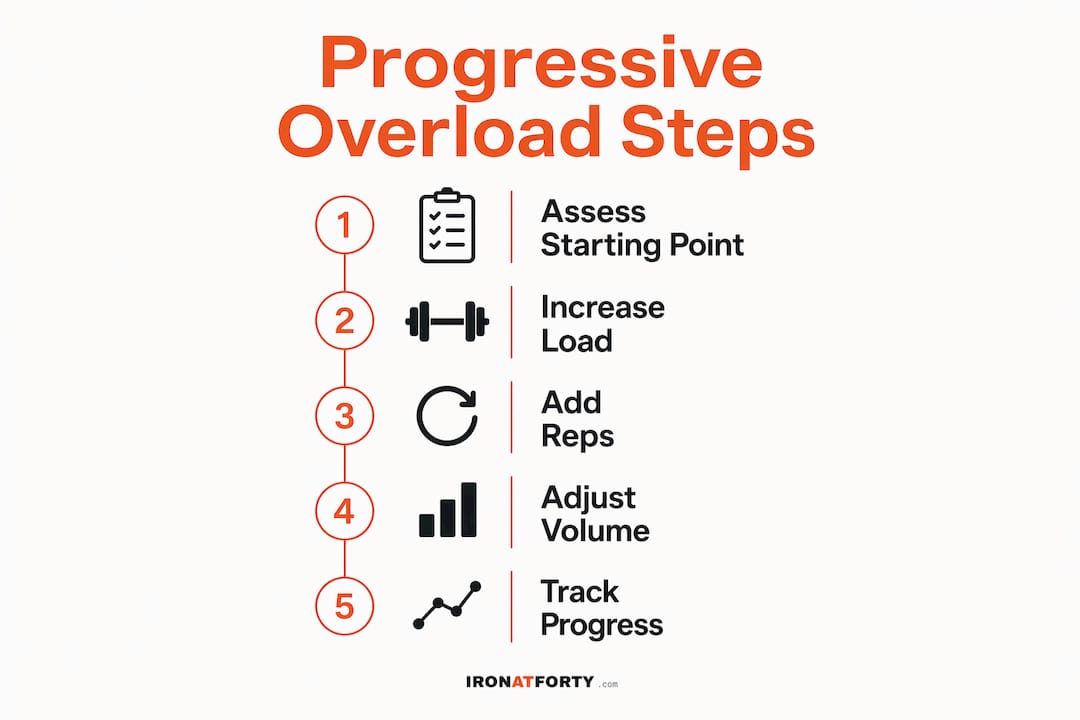
Progressive overload is a principle, not a single technique. Most lifters think it means adding weight to the bar every week. That narrow view causes plateaus and injuries, especially for older lifters. The real definition covers five core variables: load, volume, frequency, exercise selection, and tempo. You can manipulate any one of them to create a productive training stimulus.
After 40, your body still responds to progressive overload. The adaptation process works the same way it did at 25. What changes is the recovery window and the margin for error. Push too hard, too fast, and you spend two weeks nursing a shoulder instead of training. The goal is consistent, planned progression over months, not heroic single sessions.

The benefits of progressive overload extend beyond muscle size. Bone density improves, connective tissue strengthens, and neuromuscular coordination sharpens. These adaptations matter more at 45 than they did at 25, because the cost of losing them is higher.
What are the core variables you can manipulate?
The five variables of progressive overload give you multiple levers to pull. That flexibility is exactly what makes the principle so useful for mid-life lifters.
| Variable | What it means | Mid-life application |
|---|---|---|
| Load | The weight on the bar | Use micro-plates; increase by 0.5–2.5 lbs |
| Volume | Total sets and reps per week | Target 10+ sets per muscle group weekly |
| Frequency | How often you train a muscle | 3–4 sessions per week per muscle pattern |
| Exercise selection | Which movements you choose | Rotate variations to reduce joint stress |
| Tempo | Speed of each rep phase | Use a 3-second eccentric to protect tendons |
Research on hypertrophy for mid-life adults shows that sets of 6–15 reps taken close to failure, at an RPE of 7–9, maximize muscle growth safely. That means leaving 1–3 reps in the tank at the end of each set. You are not sandbagging. You are protecting your connective tissue while still driving adaptation.
Volume is the variable most lifters underestimate. Hitting 10 or more sets per muscle group per week produces significantly better hypertrophy results than lower volumes. Spread those sets across multiple sessions rather than cramming them into one day. Your muscles recover faster, and your joints stay healthier.
Pro Tip: If you cannot add weight this week, add one rep to two of your sets. That counts as progressive overload. Small wins compound over months.
How does progressive overload protect your joints and prevent injury?
Proper progression is one of the best injury prevention tools available. Random, unplanned training is the real injury risk. Consistent, planned progression builds neuromuscular confidence and keeps load increases predictable enough for tendons and ligaments to adapt alongside muscles.
Here are the key injury prevention strategies that belong in every progressive overload program after 40:
- Warm up for 10–15 minutes before every session. Include mobility work and progressive loading, not just a light cardio jog.
- Use a 3-second eccentric on compound lifts. Controlled lowering builds tendon resilience and reduces acute injury risk.
- Increase load gradually. Jumping 10 lbs on a barbell press when your tendons are not ready is how rotator cuffs get torn.
- Schedule deload weeks every 6–12 weeks, reducing volume or intensity by 30–40%. This resolves accumulated fatigue before it becomes an injury.
- Track how you feel. Life stress, poor sleep, and work pressure all affect training readiness. Ignoring them is not toughness. It is poor programming.
A 10–15 minute warm-up with mobility work and progressive loading is the standard recommendation for masters lifters. It is not optional. Skipping it to save time is the fastest way to lose weeks of training to a preventable strain.
Pro Tip: Add a 3-second count on the way down for every pressing and squatting movement. You will feel the difference in your joints within two weeks.
What are practical progressive overload examples for lifters over 40?
Concrete examples make this principle real. Here are the most effective progressive overload methods, ranked from lowest to highest joint stress for mid-life lifters.
- Add reps within your target range. If you are doing 3 sets of 8 and your program calls for 6–12 reps, push to 10 reps before adding weight. This is the safest first step.
- Add a set. Going from 3 sets to 4 sets on a key exercise increases volume without touching the load. Your joints will thank you.
- Use micro-plates to increase load. Micro-progressions using 0.5–2.5 lb increments are safer and more sustainable than jumping 5–10 lbs per session. Most commercial gyms have fractional plates if you ask.
- Apply the 2-for-2 rule. If you complete 2 extra reps on your last set for 2 consecutive sessions, increase the weight at the next session. This rule removes guesswork.
- Slow the tempo. Adding a 2-second pause at the bottom of a squat or a 3-second eccentric on a row increases time under tension without adding a single pound.
- Increase training frequency. Moving a muscle from once to twice per week is a significant volume increase. Do it gradually over 3–4 weeks.
Here is a sample four-week progression for a dumbbell bench press, starting at 3 sets of 8 reps at 50 lbs:
| Week | Sets | Reps | Load | Change |
|---|---|---|---|---|
| Week 1 | 3 | 8 | 50 lbs | Baseline |
| Week 2 | 3 | 10 | 50 lbs | +2 reps |
| Week 3 | 4 | 8 | 50 lbs | +1 set |
| Week 4 | 3 | 8 | 52.5 lbs | +2.5 lbs load |
This is not complicated. It is deliberate. That deliberateness is what separates lifters who keep making progress from those who spin their wheels for years.
How does recovery change progressive overload programming after 40?
Recovery is where the adaptation actually happens. Training is just the stimulus. After 40, recovery windows extend to 48–72 hours, which means the same muscle group needs more time between sessions than it did in your twenties. This is not weakness. It is biology.
Training 3–4 days per week hits the sweet spot for most lifters over 40. That frequency allows enough stimulus for adaptation while giving connective tissue time to recover fully. Trying to train 6 days a week on a program designed for a 22-year-old is a recipe for chronic fatigue, not gains.
The training frequency guide at Ironatforty covers this in detail, but the short version is this: more is not always more. Productive stress drives adaptation. Maximum fatigue just breaks you down.
RPE tracking is the most practical tool for managing intensity after 40. Using RPE 7–9 means you leave 1–3 reps in reserve on most working sets. You are training hard enough to grow, but not so hard that your nervous system needs five days to recover. Heart rate variability monitoring adds an objective layer if you want to go deeper on readiness tracking.
Pro Tip: Plan a deload week every 6–12 weeks. Cut volume by 30–40% and keep intensity moderate. You will come back stronger, not weaker. This is not a rest week. It is a recovery investment.
Key Takeaways
Progressive overload is the non-negotiable foundation of strength training after 40, and applying it through volume, tempo, and micro-progressions produces safer, more consistent results than chasing heavier weights.
| Point | Details |
|---|---|
| Progressive overload is a principle | It covers load, volume, frequency, exercise selection, and tempo, not just adding weight. |
| Volume drives hypertrophy after 40 | Target 10+ sets per muscle per week at RPE 7–9 for safe, consistent muscle growth. |
| Micro-progressions protect joints | Use 0.5–2.5 lb increments and the 2-for-2 rule to progress without overloading tendons. |
| Recovery windows expand with age | Allow 48–72 hours between sessions for the same muscle group; train 3–4 days per week. |
| Deloads are mandatory, not optional | Reduce volume by 30–40% every 6–12 weeks to prevent overuse injuries and sustain progress. |
The uncomfortable truth about progressive overload after 40
Here is what I have seen over and over: lifters over 40 either train like they are still 25, or they back off so much that they stop making progress entirely. Both extremes are wrong.
The lifters who chase maximal weights every session eventually get hurt. The lifters who never push hard enough never adapt. The answer sits in the middle, and it requires more patience than most people are willing to commit to. Micro-progressions feel slow. Adding one rep to a set does not feel like progress. But over 12 months, those small wins stack into real strength.
The other thing I want to challenge is the idea that you need a perfectly periodized program to apply progressive overload. You do not. You need a log, a plan for the next session, and the discipline to follow it. Write down what you did. Beat it next time by one rep, one set, or 2.5 lbs. That is the whole system.
What actually derails most mid-life lifters is not the training. It is the recovery. Skipping sleep, eating too little protein to support muscle, and ignoring life stress all blunt the adaptation signal. Progressive overload works when the full picture supports it.
— Iron@40 Staff
Ironatforty has the tools to back your training
Knowing the principle is step one. Applying it consistently over months is where most lifters need support.
Ironatforty publishes science-backed training guides for mid-life lifters that cover programming, volume management, and injury prevention in plain language. The site also offers nutrition resources built specifically for adults over 40, covering protein targets, meal timing, and recovery nutrition. For lifters managing joint issues alongside their training, the joint health section provides practical strategies to keep you under the bar long-term. Free tools like the TDEE Calculator help you align your calorie intake with your training demands so your body has the fuel to actually adapt. Everything is free, no coach required.
FAQ
What is progressive overload in simple terms?
Progressive overload is the practice of gradually increasing training stress, through more weight, reps, sets, or tempo changes, so your muscles are forced to adapt and grow stronger over time.
How often should lifters over 40 increase their training load?
Increase load or volume every 1–2 weeks using the 2-for-2 rule: if you hit 2 extra reps on your last set for 2 consecutive sessions, add weight at the next session.
Can progressive overload cause injury if applied incorrectly?
Yes. Jumping load too quickly, skipping warm-ups, and ignoring recovery signals are the primary causes of overuse injuries in mid-life lifters. Micro-progressions and planned deloads prevent this.
What rep range works best for progressive overload after 40?
Research supports a mixed rep range of 6–20 reps, with most working sets in the 6–15 range taken to an RPE of 7–9. This builds muscle safely without excessive joint stress.
Do I need to track my workouts to apply progressive overload?
Tracking is non-negotiable. Without a training log, you cannot know whether you are progressing, stagnating, or regressing. A simple notebook or phone note works fine.