
Periodization training is the planned, systematic variation of training variables like volume, intensity, and frequency to improve performance and manage recovery. The industry term is training periodization, and it comes from Soviet sports science research that shaped how coaches worldwide now structure programs. The National Strength and Conditioning Association (NSCA) and the American College of Sports Medicine (ACSM) both recognize periodization as a core framework for long-term strength development. For lifters over 40, it is not optional equipment. It is the difference between steady progress and grinding yourself into the ground.
What is periodization training and why does it matter?
Periodization training is the practice of organizing your workouts into structured time blocks, each with a specific purpose. The NSCA defines three levels of structure: the macrocycle (up to one year), the mesocycle (roughly 3–6 weeks), and the microcycle (approximately one week). Each level nests inside the next, like folders inside folders. This structure lets you plan stress, adaptation, and recovery in a deliberate sequence rather than winging it session to session.
The core logic is simple. Your body adapts to stress, then needs recovery to grow stronger. Without structure, most lifters either push too hard for too long or train inconsistently. Both paths lead to stalled progress or injury. Periodization manages the interaction between training stress and recovery across different time scales, which is exactly what your body needs more of after 40.
For older lifters, recovery slows. Hormonal output drops. Connective tissue takes longer to heal. A program that ignores these realities will eventually break you down. Periodization builds recovery into the plan by design, not as an afterthought.

What are the main types of periodization?
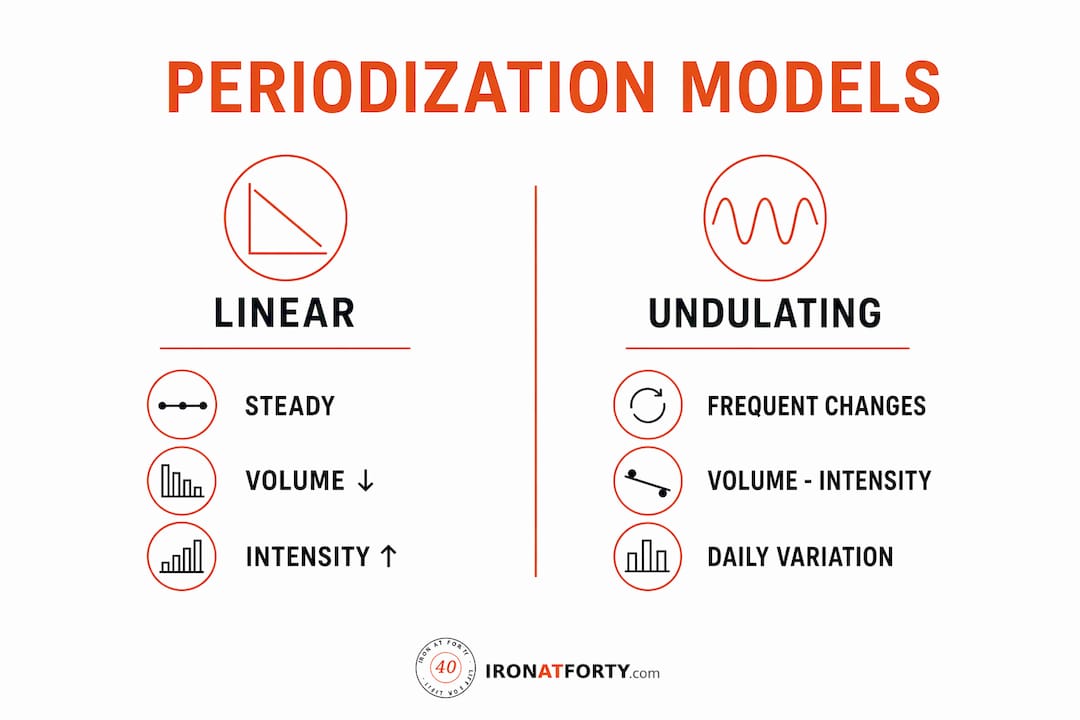
Three models dominate strength training: linear periodization, undulating periodization, and block periodization. Each handles volume and intensity differently.
| Model | Planning horizon | Volume/intensity pattern | How often variables change |
|---|---|---|---|
| Linear | 12–16 weeks | Volume drops, intensity rises steadily | Weekly |
| Undulating | 4–12 weeks | Both vary frequently | Daily or weekly |
| Block | 3–6 week blocks | One quality targeted per block | Every block |
Linear periodization is the most straightforward model. You start with higher volume and lower intensity, then progressively increase intensity while reducing volume over weeks. A classic example runs 16 weeks: the first phase sits around 65–70% of your one rep max for 10–12 reps, and the final phase pushes to 85–90% for 3–5 reps, followed by a deload. This model works well for beginners and intermediate lifters who benefit from a clear, predictable progression.
Undulating periodization changes variables more frequently, sometimes daily. Monday might be a heavy strength day at 85% of your one rep max, Wednesday a moderate hypertrophy day, and Friday a lighter volume day. This frequent variation manages fatigue and prevents adaptation from stalling. The catch is that undulating models require more careful programming. If every session becomes a grind, you defeat the purpose entirely.
Block periodization focuses each training block on one primary adaptation: accumulation (volume), intensification (load), or realization (peaking). Athletes use this model to peak for competition. For non-competitive lifters over 40, block periodization works well when you want to spend dedicated time building muscle before shifting focus to strength.
Pro Tip: If you are new to structured training, start with linear periodization. It is the easiest to follow and gives you the clearest feedback on whether your load progression is working.
How does periodization support recovery and injury prevention after 40?
Recovery is where adaptation actually happens. Training is just the stimulus. After 40, the window between productive stress and excessive stress narrows considerably, which makes planned recovery non-negotiable.
The most practical recovery tool inside any periodized program is the deload week. Deload weeks every 4–6 weeks reduce training volume by 30–50% while keeping movement patterns intact. That reduction dissipates accumulated fatigue without losing the neuromuscular coordination you have built. Think of it as letting the engine cool before you push it hard again.
Periodization also prevents overtraining by design. When your program includes planned lighter phases, you are less likely to push through warning signs until something breaks. The ACSM's position on resistance training confirms that training volume and load drive outcomes more consistently than periodization style alone. That means your deload weeks are not wasted time. They are part of the stimulus.
Here is what a solid recovery framework looks like inside a periodized plan for lifters over 40:
- Scheduled deloads. Every 4–6 weeks, cut volume by 30–50%. Do not skip this because you feel good. Fatigue masks fitness.
- Sleep as a training variable. Seven to nine hours is not a luxury. It is when growth hormone peaks and tissue repairs.
- Joint health monitoring. Track nagging aches weekly. A pattern of joint pain is a signal to pull back, not push through. The Ironatforty guide on avoiding overtraining covers the warning signs in detail.
- Warm-up investment. A proper warm-up before heavy lifting reduces acute injury risk. This matters more after 40 when tissue elasticity decreases.
Pro Tip: Do not wait until you feel beaten up to schedule a deload. Build it into the calendar before the training block starts. Reactive deloads mean you already went too far.
How to periodize your strength workouts after 40
Building a periodized program does not require a coach. It requires a clear process. Here is how to build one that works for your body and your schedule.
-
Set your training goal for the macrocycle. Pick one primary goal: strength, hypertrophy, or general fitness. Your goal determines which periodization model fits best and how you weight volume versus intensity across the year.
-
Calculate your baseline intensity. Use your one rep max to set load targets for each phase. Training at loads of 80% or more of your one rep max, two to three times per week, drives the strength gains the ACSM links to meaningful outcomes.
-
Map your mesocycles. Plan 3–6 week blocks with a specific focus. A simple three-block structure: accumulation (higher volume, moderate load), intensification (lower volume, higher load), and deload. Repeat and progress.
-
Set your weekly microcycle. Decide how many days per week you train each muscle group. The training frequency guide at Ironatforty breaks down the right frequency for older lifters in detail.
-
Track and adjust. Log every session. If you miss reps you should be hitting, the load is too high or fatigue is too high. Adjust before the next session, not after three weeks of grinding.
Avoid these common mistakes:
- Making every session maximum effort. Proper fatigue management requires planned lighter sessions, not constant maximal output.
- Skipping deloads when you feel strong. Feeling strong is often a sign fatigue has not yet peaked.
- Changing programs every few weeks. Periodization only works if you stay in the plan long enough to see the adaptation.
Your training age also shapes how you periodize. A lifter with ten years of experience needs different volume and intensity targets than someone who returned to the gym at 45.
Common misconceptions about periodization training
The biggest myth is that periodization is only for competitive athletes or powerlifters peaking for a meet. That is wrong. Periodization applies to any training goal where consistent results matter, including general strength, body composition, and long-term joint health.
Here are the most common misconceptions, and what the evidence actually says:
- "I need to follow one model strictly." No model is universally superior. The ACSM's overview makes clear that training volume and load are the primary drivers of strength and hypertrophy. Periodization organizes those variables. It is a scheduling tool, not the stimulus itself.
- "Undulating periodization is always better because it prevents adaptation." Undulating models work well, but they require discipline. Making every session hard defeats the fatigue management purpose entirely.
- "Periodization means I need a complicated spreadsheet." A simple three-phase structure with planned deloads is enough. Complexity does not equal effectiveness.
- "If I feel good, I can skip the deload." Fatigue accumulates invisibly. Planned step-backs every 4–6 weeks protect progress even when you feel fine.
- "Periodization guarantees results." Consistent, well-prescribed training is the foundation. Periodization is the framework that keeps it sustainable over months and years.
The honest takeaway: get your core variables right first. Lift at appropriate loads, hit adequate weekly volume, and recover properly. Then use periodization to schedule when and how those variables shift over time.
Key takeaways
Periodization training is the most practical tool for managing training stress and recovery over time, and it matters most for lifters over 40 who cannot afford to ignore recovery.
| Point | Details |
|---|---|
| Core definition | Periodization structures volume, intensity, and frequency into planned cycles for consistent progress. |
| Three main models | Linear, undulating, and block periodization each suit different goals and experience levels. |
| Deloads are mandatory | Cutting volume by 30–50% every 4–6 weeks dissipates fatigue and protects long-term progress. |
| Variables drive results | Training load and volume matter more than periodization style, per ACSM guidance. |
| Avoid maximal effort every session | Planned lighter sessions are not weakness. They are how fatigue management actually works. |
What I have learned training past 40
The thing nobody tells you about periodization is that the deload week feels like failure the first time you do it. You are in the gym, the weights feel light, and your brain says you are wasting time. You are not. You are doing the most important work of the whole training block.
I spent years training without structure, chasing PRs every session. The result was a shoulder that complained for six months and a squat that stalled for a year. When I finally built deloads into the plan and stopped treating every workout like a test, progress came back and stayed. That is the real value of periodization for lifters over 40. It is not a magic formula. It is a permission structure that forces you to back off before your body forces you to.
My honest advice: do not obsess over which periodization model is theoretically optimal. Pick linear if you are newer to structured training. Add undulating variation once you understand how your body responds to load changes. Keep the deloads sacred. And pay attention to your training frequency as much as your intensity. Over 40, how often you train a muscle matters as much as how hard you hit it.
The lifters I see making consistent progress past 40 are not the ones with the most sophisticated programs. They are the ones who show up consistently, manage fatigue honestly, and do not let ego override the plan.
— Jeff
Ironatforty: built for serious lifters over 40
Ironatforty publishes science-backed training and nutrition content written specifically for adults over 40 who lift weights and want real guidance, not recycled gym advice.

If you are ready to build a periodized program that fits your recovery capacity and your life, Ironatforty's free training tools give you a practical starting point. The 1RM Calculator helps you set accurate load targets for each training phase. The TDEE Calculator helps you align your nutrition with your training demands. No coach required. Just the right tools and the knowledge to use them.
FAQ
What is periodization training in simple terms?
Periodization training is the practice of organizing your workouts into planned phases that vary volume, intensity, and frequency over time. The goal is to build fitness progressively while managing fatigue and reducing injury risk.
Is periodization training necessary for lifters over 40?
Periodization is not mandatory, but it is the most practical way to manage recovery and maintain progress as you age. Planned deloads and structured progression protect joints and prevent the overtraining that derails most older lifters.
How often should you deload in a periodized program?
Deload every 4–6 weeks by reducing training volume by 30–50%. This dissipates accumulated fatigue while preserving the movement patterns and strength you have built.
Which type of periodization is best for strength training after 40?
Linear periodization is the best starting point for most lifters over 40. It is predictable, easy to track, and gives clear feedback on whether your load progression is working before you add complexity.
Does periodization work for non-athletes?
Yes. Periodization applies to any training goal where consistent results matter. The ACSM confirms that planned variation and fatigue management benefit general lifters, not just competitive athletes.