
Tempo training is defined as the practice of controlling exercise movement speed through a four-phase prescription, assigning specific seconds to each part of a lift to maximize muscle engagement and reduce injury risk. For lifters over 40, this is not a minor tweak. It is a fundamental shift in how you approach the bar. Slowing down your reps forces better mechanics, builds time under tension as a driver for hypertrophy, and protects the connective tissues that take longer to recover as you age. The industry standard for prescribing tempo is the 4-digit notation format, and understanding it changes how you read every program you follow.
What is tempo training explained: the four phases
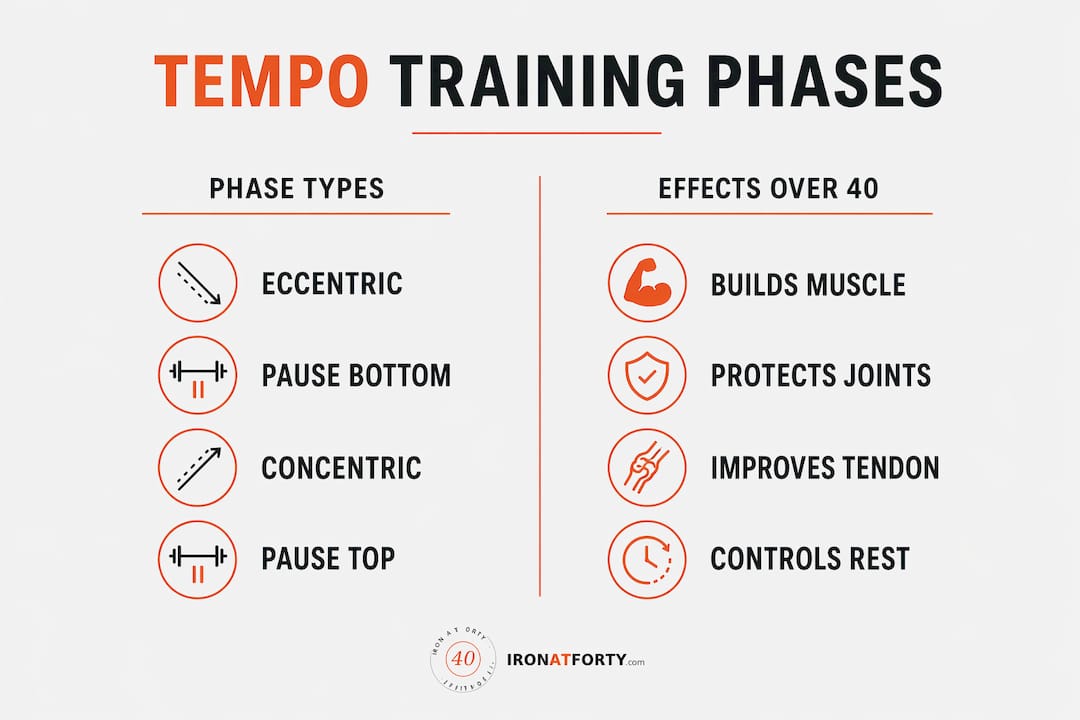
Tempo training uses a 4-digit prescription to assign seconds to four distinct movement phases. Each digit represents one phase of the lift, read left to right.
- Eccentric phase (digit 1): The lowering portion. In a squat, this is the descent. A "3" means you take 3 seconds to lower yourself.
- Bottom pause (digit 2): The pause at the end of the eccentric. A "1" means a 1-second hold at the bottom of the squat.
- Concentric phase (digit 3): The lifting portion. A "1" means you take 1 second to stand back up.
- Top pause (digit 4): The pause at the top before the next rep. A "0" means no pause at the top.
So a tempo of 3-1-1-0 on a squat means: 3 seconds down, 1-second pause at the bottom, 1 second up, no pause at the top. That single set of four numbers completely defines the rhythm of your lift.
One notation that confuses people is the letter "X." In tempo prescriptions, "X" means maximum volitional intent, not a literal speed. You apply full explosive force on that phase, even if the bar moves slowly because the load is heavy. This matters most in power training, where intent drives neuromuscular recruitment regardless of actual bar speed.

The fourth digit also controls inter-rep rest. The top pause governs total time under tension without changing the load. A 3-1-1-2 tempo adds 2 seconds of rest between reps, increasing metabolic fatigue across the set. That is a meaningful programming variable most lifters never touch.
Pro Tip: Write your tempo prescription on your phone before each session. Counting silently in your head while lifting is harder than it sounds, especially on heavy sets.
How does tempo training build muscle and protect your joints after 40?
Time under tension is the primary mechanism. For hypertrophy, 30–60 seconds of TUT per set is the recommended target. For strength, the focus shifts to controlled eccentrics with explosive concentric effort at lower rep ranges. These are not interchangeable goals. Choosing the wrong TUT range for your objective wastes weeks of training.
Here is why this matters more after 40. Your tendons and connective tissues adapt more slowly than your muscles. A 25-year-old can get away with sloppy, fast reps because their recovery systems are running hot. You cannot. Slowing the eccentric phase enhances tendon resilience and reduces injury risk in a way that faster reps simply do not.
The neuromuscular benefits are just as real. Controlling movement speed forces you to actually feel the muscle working. That mind-muscle connection is not just gym talk. It improves motor unit recruitment and helps you identify weak links in a movement pattern before they become injuries. Slower tempos reveal stability weaknesses that faster reps hide entirely.
The practical benefits stack up like this:
- Hypertrophy: Use a 3-1-1-0 or 4-0-1-0 tempo. Keep TUT in the 30–60 second range per set. This creates the metabolic stress and mechanical tension needed for muscle growth.
- Strength: Use a 3-1-X-0 tempo. The eccentric is controlled, the concentric is explosive intent. Lower reps, heavier load, full recovery between sets.
- Connective tissue health: Prioritize a 3–4 second eccentric on every compound lift. This is non-negotiable for anyone over 40 with a history of joint issues.
- Movement quality: Use slow tempos at 60–70% of your 1RM to practice mechanics without the pressure of heavy loads. Think of it as a diagnostic tool, not a deload.
What are the most common tempo training mistakes after 40?
Rushing the eccentric is the single most common error. Most lifters drop the weight fast and grind through the concentric. That approach removes the very stimulus that makes tempo training effective. Rushing the eccentric phase is the most common mistake for people over 40, and it directly undermines tendon health and hypertrophy.
Here are the mistakes that show up most often, and how to fix them:
- Ignoring the bottom pause: Skipping the pause at the bottom of a squat or bench press lets you use the stretch reflex as a shortcut. That shortcut reduces muscle activation and puts stress on passive structures like ligaments.
- Ego-loading: Tempo training enforces discipline by forcing control under load. If you cannot maintain your prescribed tempo, the weight is too heavy. Drop it. Starting at 60–70% of your 1RM is the right floor for tempo work.
- Inconsistent counting: Counting "one, two, three" in your head while fatigued is unreliable. Use a metronome app or count "one-one-thousand, two-one-thousand" for accuracy.
- Applying tempo to every exercise: Tempo is most valuable on compound lifts and movements where form breaks down under fatigue. Applying a strict 4-second eccentric to a kettlebell swing is counterproductive.
Pro Tip: If you want to see where your form actually falls apart, try a 4-0-1-0 tempo on your main compound lift at 65% of your one rep max. The slow descent will expose every stability leak you have been hiding.
Avoiding overtraining is equally important when you add tempo work. Slower reps increase time under tension, which increases muscle damage per set. That means your recovery needs after 40 go up when you first introduce tempo training. Reduce total volume by 10–20% in the first two weeks.
How to integrate tempo training into your program
Tempo manipulation changes training intent across four dimensions: mechanics, metabolic demand, progression, and control. That means you can use tempo as a tool for different goals within the same program, not just as a single method.
Here is a practical approach for lifters over 40:
- Start with mechanics. Spend the first 2–4 weeks using a 3-1-1-0 tempo at 60–70% 1RM on your main lifts. The goal is not fatigue. It is movement quality. Pair this with a solid warm-up protocol before every session.
- Build metabolic demand. Once mechanics are solid, increase TUT by extending the eccentric to 4 seconds or adding a top pause. Keep load the same. This is where hypertrophy work lives.
- Progress via load. When you can complete all sets with perfect tempo at a given weight, add 5% load and return to a slightly faster tempo. This is how tempo drives progressive overload without chasing PRs recklessly.
- Periodize your tempo. Rotate tempo prescriptions across training blocks. A strength block uses 3-1-X-0. A hypertrophy block uses 4-0-1-0. A deload uses 2-0-2-0 at very light loads to flush fatigue while maintaining movement patterns.
The table below shows how to match tempo to training goals:
| Goal | Recommended tempo | TUT per set | Load range |
|---|---|---|---|
| Movement mechanics | 3-1-1-0 | 20–30 seconds | 60–65% 1RM |
| Hypertrophy | 4-0-1-0 | 30–60 seconds | 65–75% 1RM |
| Strength | 3-1-X-0 | 15–25 seconds | 75–85% 1RM |
| Metabolic conditioning | 2-0-1-2 | 40–60 seconds | 55–65% 1RM |
Your training frequency also needs to account for the increased demand tempo work places on recovery. Three to four sessions per week is the right ceiling for most lifters over 40 using tempo prescriptions on compound movements.
What is tempo running and how does it differ from resistance training tempo?
Tempo running is a completely different concept that shares the same name. Tempo running is a sustained effort at lactate threshold pace, described as a "comfortably hard" effort at RPE 7–8 out of 10. It is typically performed for 20–40 minutes continuously, or broken into intervals such as 5 sets of 8 minutes with 90-second recovery periods.
The physiological goal of tempo running is to raise your lactate threshold, which improves endurance performance. The goal of tempo training in resistance exercise is to control muscle activation, TUT, and movement mechanics. These are separate tools for separate purposes.
| Feature | Tempo running | Resistance tempo training |
|---|---|---|
| Primary goal | Raise lactate threshold | Control TUT and mechanics |
| Duration | 20–40 minutes per session | Per-set prescription (seconds) |
| Effort level | RPE 7–8/10 | Load-dependent |
| Best for | Endurance athletes | Strength and hypertrophy |
If you train for both strength and endurance, you can use both methods in the same program. They do not conflict. Just keep them in separate sessions to avoid compromising the quality of either.
Key Takeaways
Tempo training is the most underused tool in strength programming for lifters over 40, delivering hypertrophy, joint protection, and movement quality from a single variable.
| Point | Details |
|---|---|
| Four-phase notation | A 4-digit tempo prescription assigns seconds to eccentric, bottom pause, concentric, and top pause phases. |
| TUT drives hypertrophy | Target 30–60 seconds of time under tension per set for muscle growth; use controlled eccentrics for strength. |
| Eccentric phase is critical | A 3–4 second lowering phase builds tendon resilience and reduces injury risk for lifters over 40. |
| Start at 60–70% 1RM | Use lighter loads when introducing tempo to correct form before adding weight. |
| Tempo is a programming tool | Rotate tempo prescriptions across training blocks to address mechanics, hypertrophy, strength, and recovery. |
Why tempo training changed how I think about lifting after 40
I spent years chasing heavier numbers. More plates, faster reps, shorter rest. That mindset works when you are 28. It starts breaking you down when you are past 40.
The first time I applied a strict 4-0-1-0 tempo to my Romanian deadlift at 65% of my working weight, I felt muscles I thought I was already training. My hamstrings were on fire by rep 6. My lower back, which had been a chronic problem, was not involved at all. That is the diagnostic power of tempo. It shows you exactly what is doing the work and what is compensating.
What I have seen consistently is that lifters over 40 who embrace tempo training stop getting hurt. Not because they are lifting less. Because they are lifting with control. The discipline tempo forces is the same discipline that training longevity requires. You stop ego-lifting because the tempo makes ego-lifting impossible. You cannot fake a 4-second eccentric.
The patience required is real. Your first few weeks of tempo work will feel humbling. The weights will feel light and the reps will feel slow. Stick with it. The strength and body composition changes that follow are more durable than anything you built by grinding through sloppy reps. Lifting smarter is not a consolation prize. It is the actual strategy.
— Jeff
Ironatforty's training and nutrition resources for lifters over 40
Tempo training works best when it is part of a complete program, not a standalone fix. Ironatforty publishes science-backed guidance on strength training after 40, including programming frameworks, recovery strategies, and joint health protocols built specifically for aging athletes.

The free tools on Ironatforty make it easier to apply what you learn. Use the 1RM Calculator to find your working loads before setting tempo prescriptions. Use the TDEE Calculator to make sure your nutrition supports the increased demand that tempo work places on recovery. Pair those tools with the nutrition guidance on the site and you have a complete system, not just a technique.
FAQ
What is tempo training in simple terms?
Tempo training is controlling how fast or slow you move through each phase of a lift. A 4-digit number assigns seconds to the lowering, bottom pause, lifting, and top pause phases of every rep.
What does the "X" mean in a tempo prescription?
"X" means maximum volitional intent. You apply full explosive effort on that phase, even if the bar moves slowly due to the weight. It is about intent, not actual speed.
How long should a set last with tempo training?
For hypertrophy, target 30–60 seconds of total time under tension per set. For strength, 15–25 seconds with heavier loads and explosive concentric effort is the standard range.
Is tempo training safe for people over 40?
Tempo training is one of the safest approaches for lifters over 40. Slowing the eccentric phase builds tendon resilience and forces better mechanics, which directly reduces injury risk at the joints.
How is tempo training different from tempo running?
Tempo running is a sustained cardio effort at lactate threshold pace for 20–40 minutes. Resistance training tempo is a per-rep prescription controlling movement speed for muscle and strength goals. They share a name but serve completely different purposes.